Kumon Level N Test Answers

Select a question from the horizontal menu below to view the verified answer sheet and core mathematical concepts. Click on the image to zoom in.
Kumon Middle School Math 5-Book Bundle
Recommended Study Material

Kumon Middle School Math 5-Book Bundle (Grades 6-8)

Enhance your study preparation with the complete Kumon Math workbook set. This bundle covers integers, fractions, decimals, pre-algebra, and algebra to build a strong math foundation for advanced levels.

Shop Bundle on Amazon
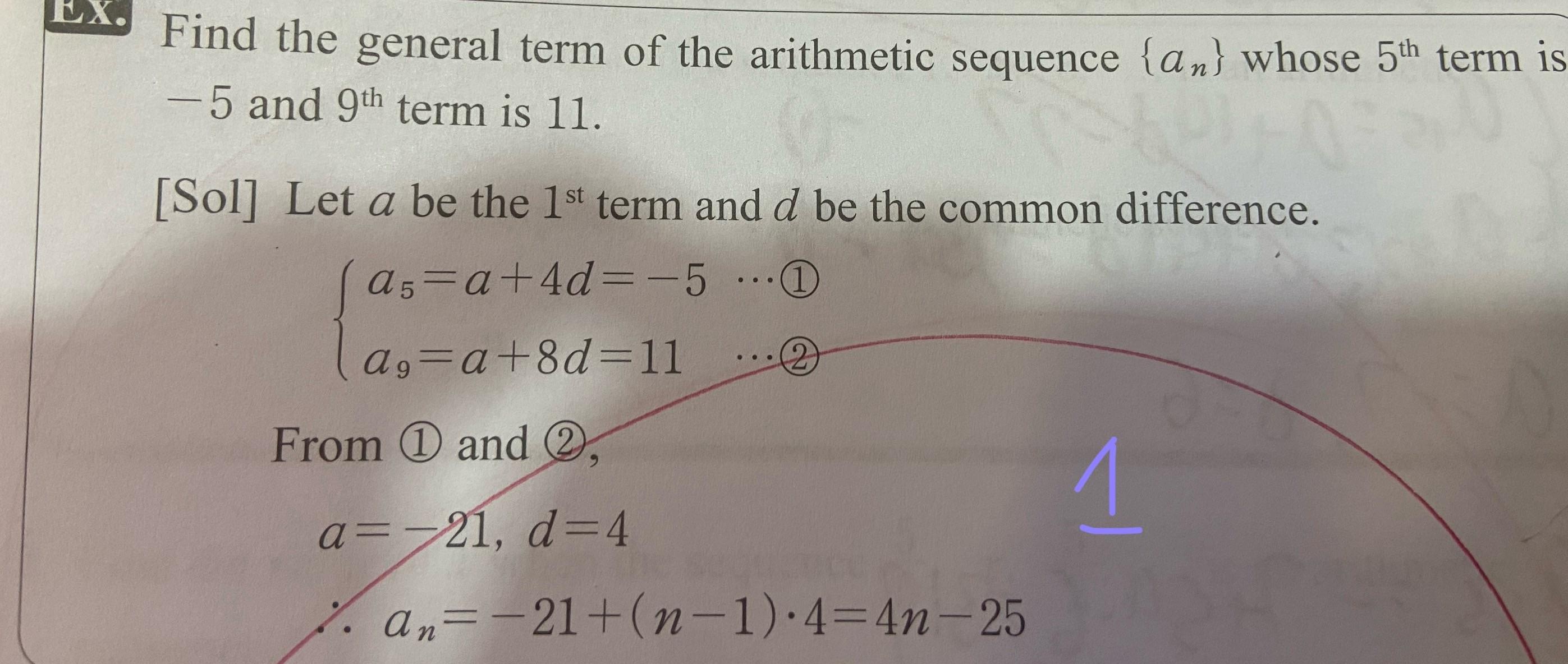
Kumon Level N Q1 Answer

Question 1: General Term of an Arithmetic Sequence

Topic: Arithmetic sequence parameters.
Concept: Finding the general term $a_n = a_1 + (n-1)d$ of an arithmetic sequence given specific terms $a_5 = -5$ and $a_9 = 11$.
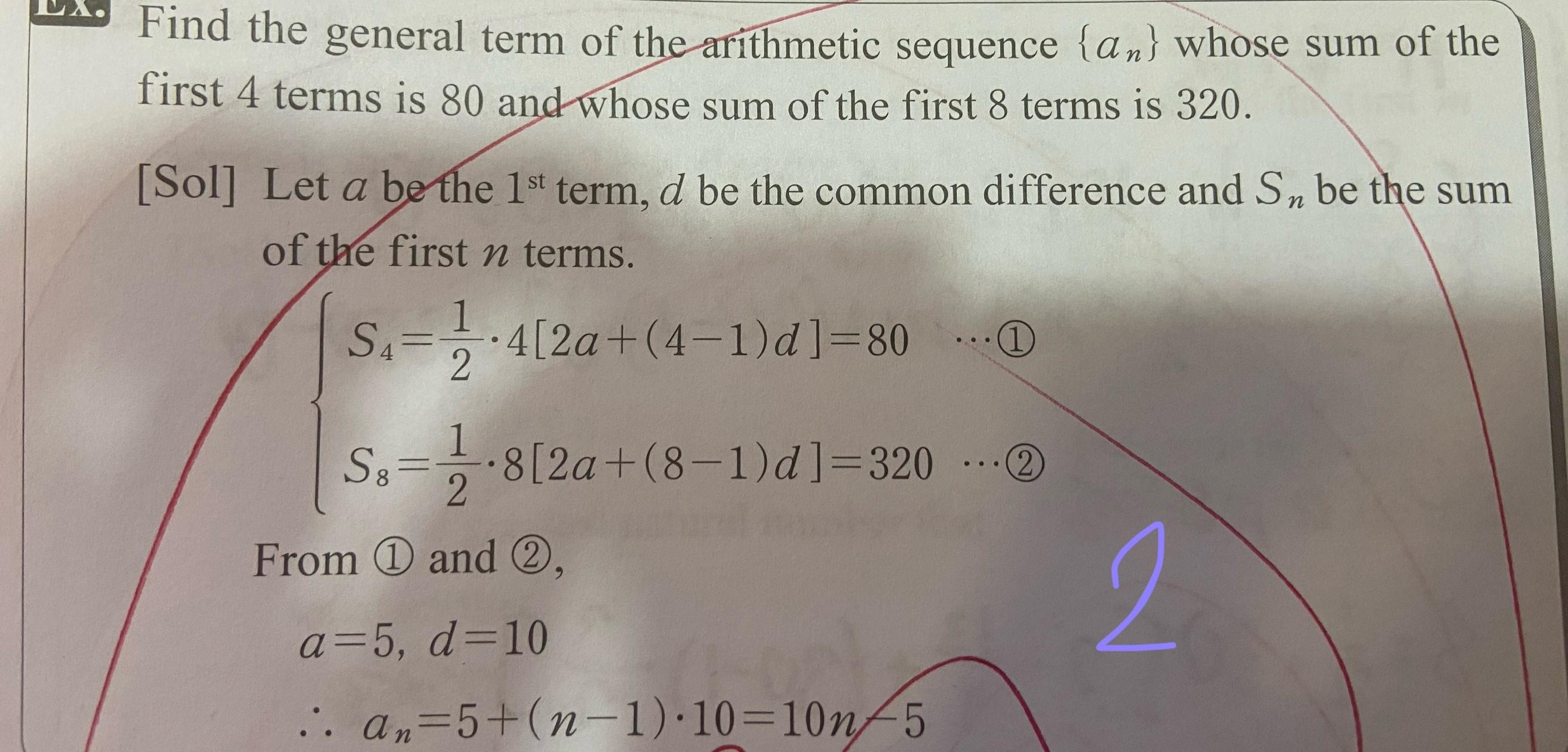
Kumon Level N Q2 Answer

Question 2: Arithmetic Sequence Sum & General Term

Topic: Sum of arithmetic progressions.
Concept: Deriving the first term $a_1$ and common difference $d$ using the sum equations $S_4 = 80$ and $S_8 = 320$, where $S_n = \frac{n}{2}[2a_1 + (n-1)d]$.
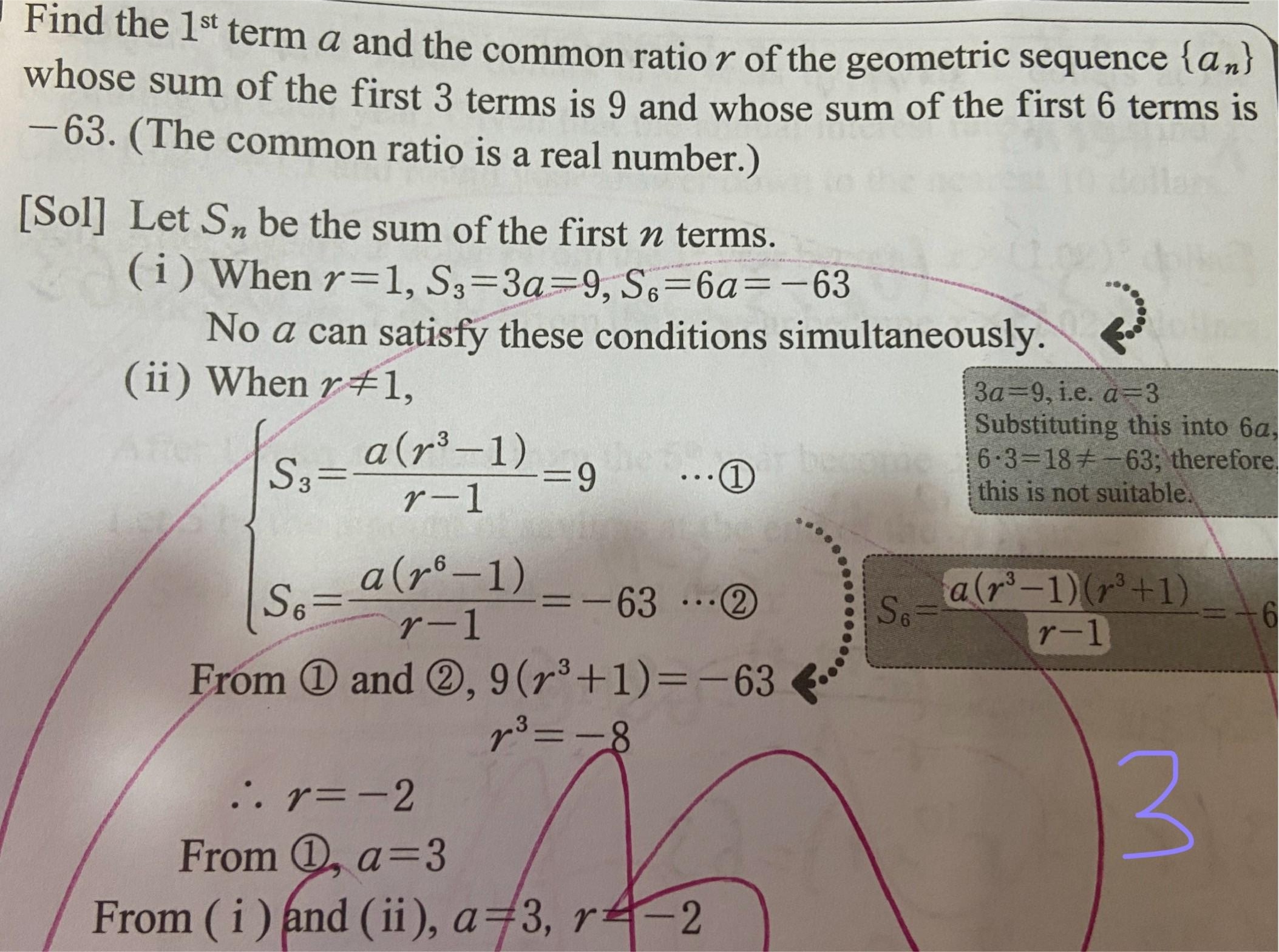
Kumon Level N Q3 Answer

Question 3: Terms of a Geometric Sequence

Topic: Geometric progression sums.
Concept: Determining the first term $a$ and common ratio $r$ of a geometric sequence given sums of terms $S_3 = 9$ and $S_6 = -63$, utilizing $S_n = \frac{a(1-r^n)}{1-r}$.
Kumon Level N Q4 Answer

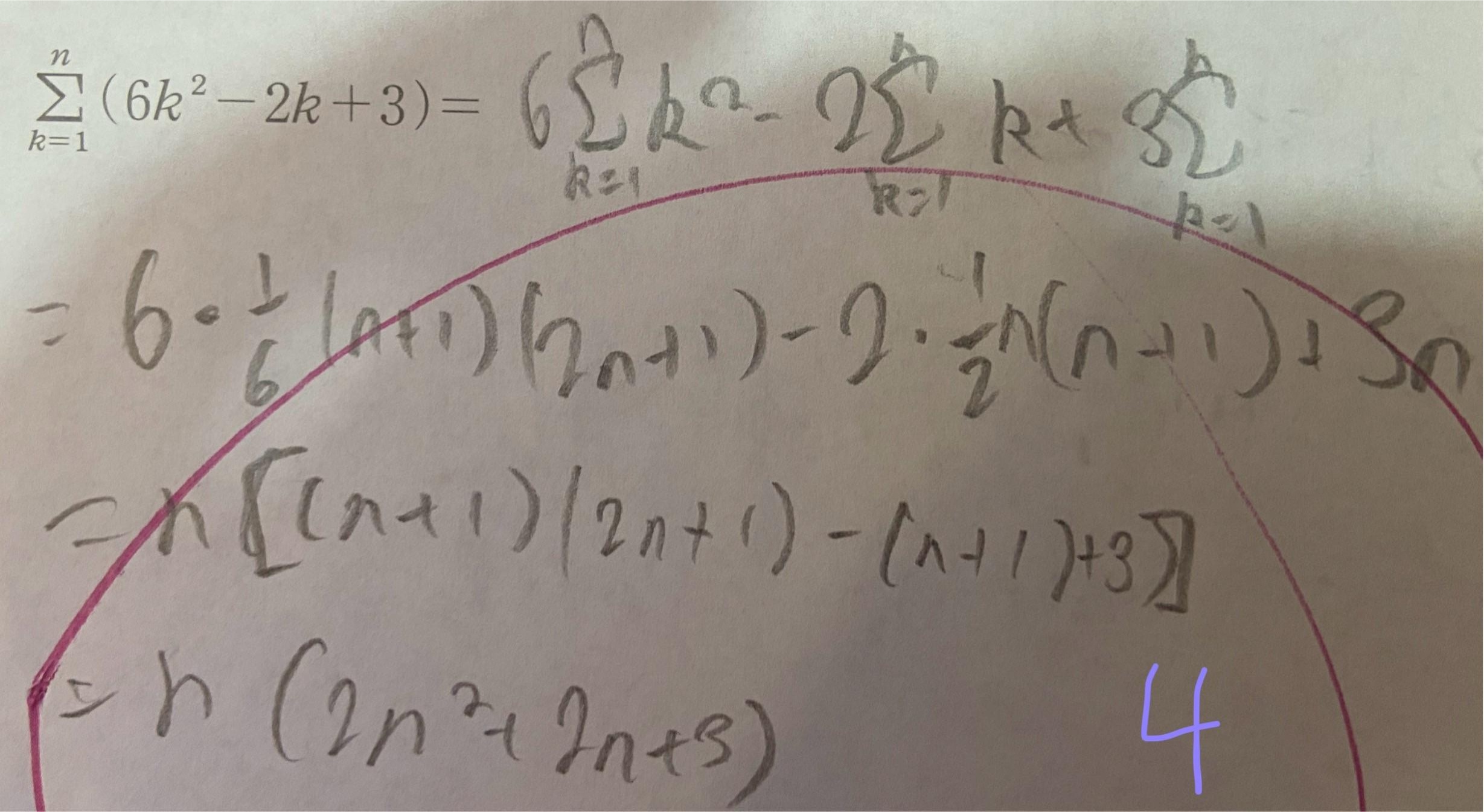
Question 4: Summation Notation Expansion

Topic: Sigma ($\sum$) series summation.
Concept: Evaluating series bounds using standard summation formulas: $\sum_{k=1}^n (6k^2 - 2k + 3) = 6\sum_{k=1}^n k^2 - 2\sum_{k=1}^n k + \sum_{k=1}^n 3$.
Kumon Level N Q5 Answer

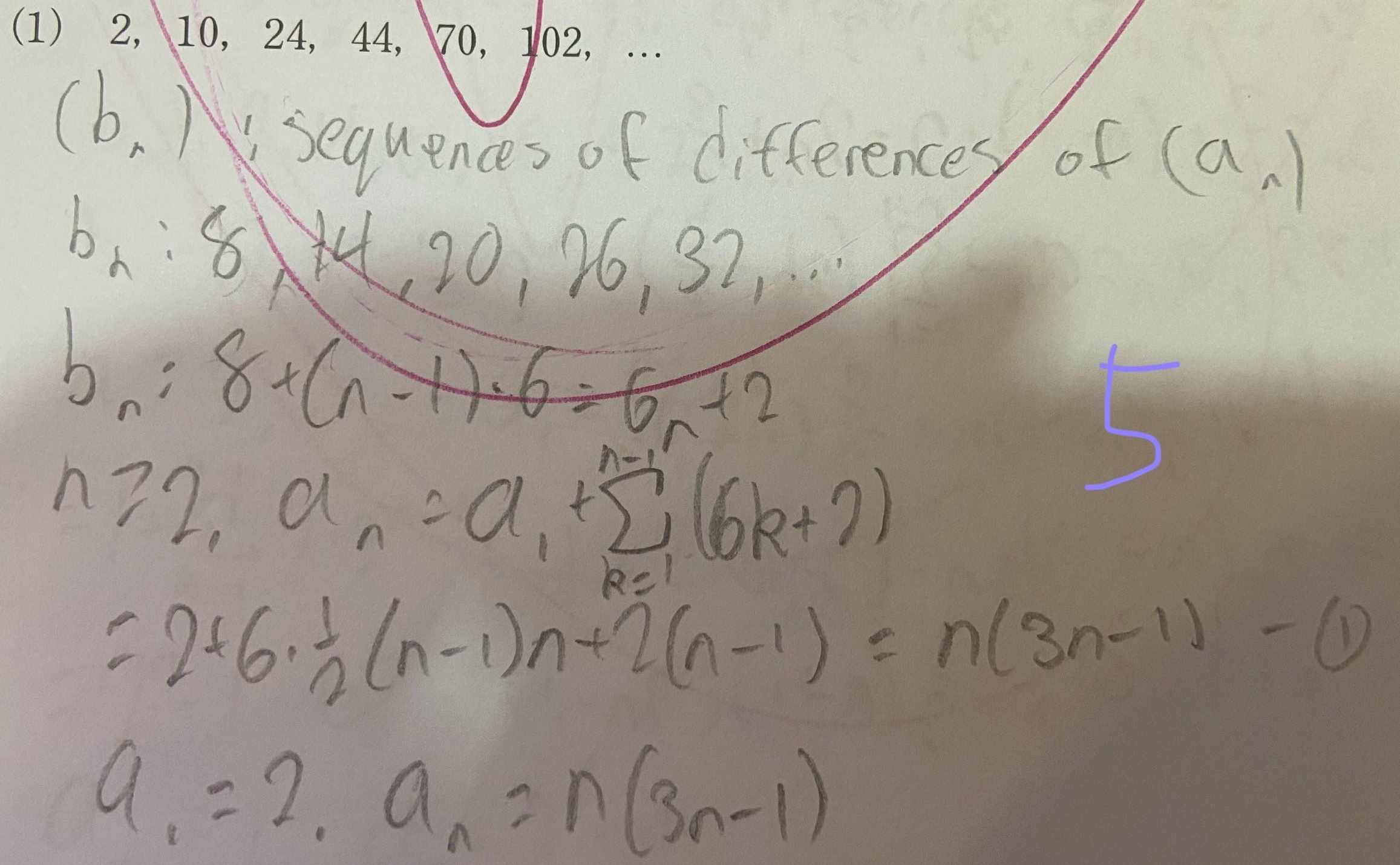
Question 5: Difference Sequences

Topic: Finding the general term via differences.
Concept: Analyzing the difference sequence $b_n = a_{n+1} - a_n$ of a given quadratic sequence $2, 10, 24, 44, \ldots$ to find its general term $a_n = a_1 + \sum_{k=1}^{n-1} b_k$.
Kumon Level N Q6 Answer

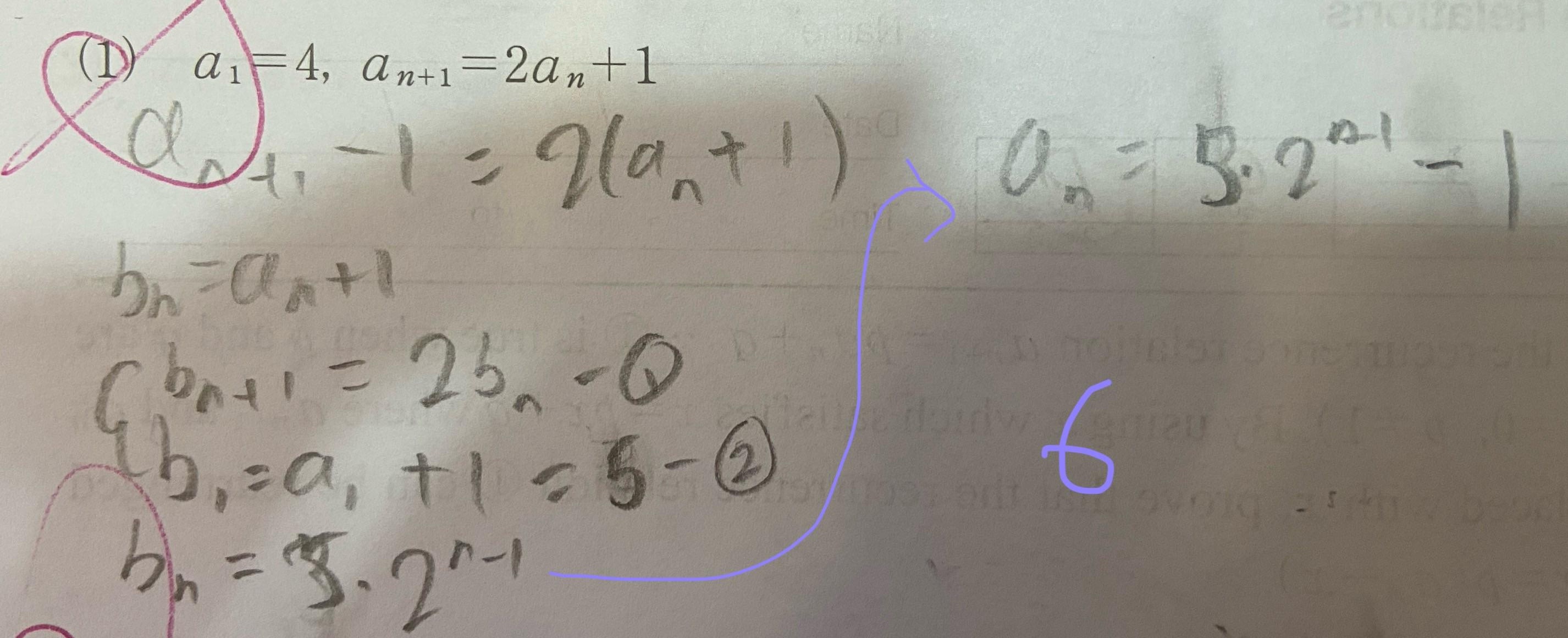
Question 6: First-Order Linear Recurrence Relations

Topic: Recurrence relations.
Concept: Solving the linear recurrence relation $a_1 = 4$ and $a_{n+1} = 2a_n + 1$ by transforming it into a geometric progression form $a_{n+1} + 1 = 2(a_n + 1)$.
Kumon Level N Q7 Answer

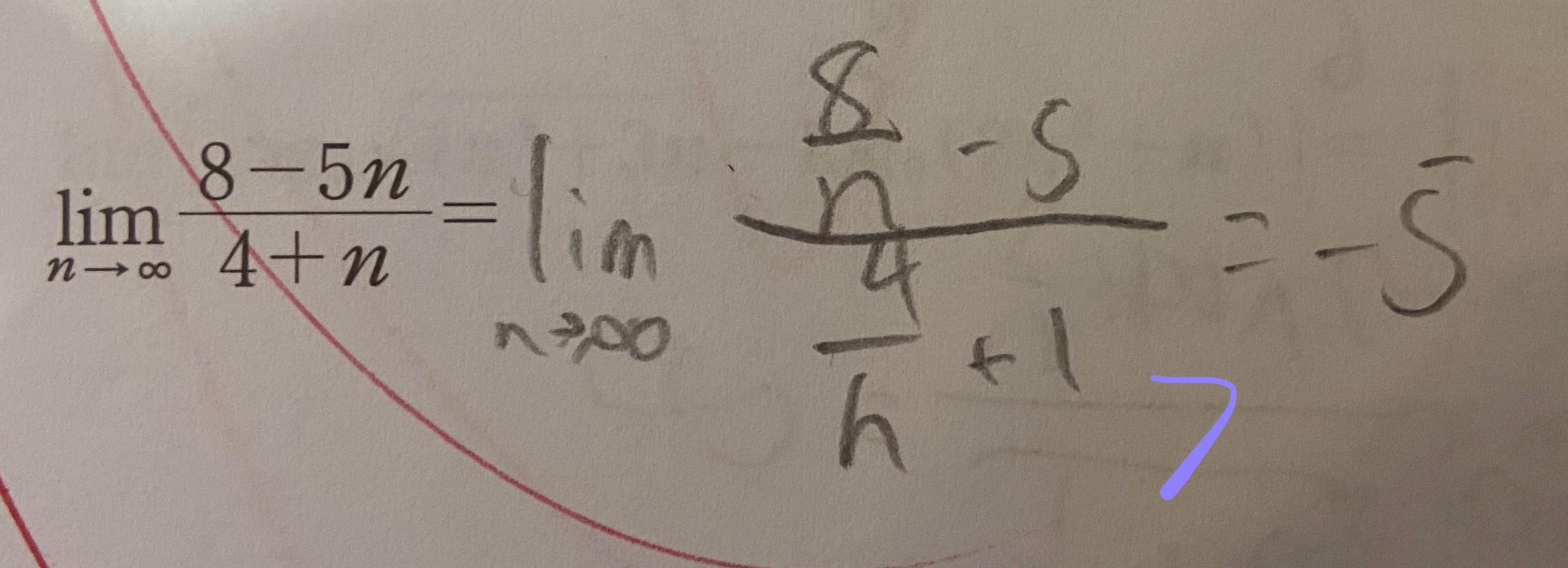
Question 7: Limits of Rational Functions at Infinity

Topic: Infinite sequence limits.
Concept: Evaluating the limit as $n \to \infty$ of a rational algebraic fraction: $\lim_{n \to \infty} \frac{8-5n}{4+n} = \lim_{n \to \infty} \frac{\frac{8}{n}-5}{\frac{4}{n}+1} = -5$.
Kumon Level N Q8 Answer

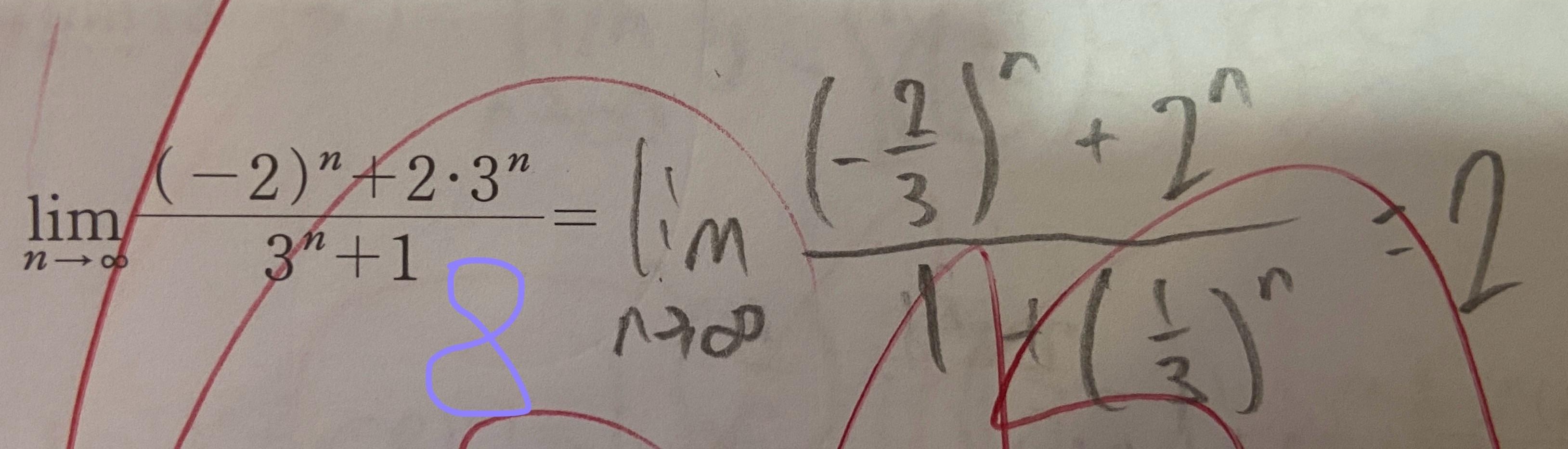
Question 8: Limits of Sequences with Exponential Bases

Topic: Limits of exponential sequence functions.
Concept: Evaluating sequence limits by dividing numerator and denominator by the dominant exponential term: $\lim_{n \to \infty} \frac{(-2)^n + 2 \cdot 3^n}{3^n + 1} = \lim_{n \to \infty} \frac{(-\frac{2}{3})^n + 2}{1 + (\frac{1}{3})^n} = 2$.
Kumon Level N Q9 Answer

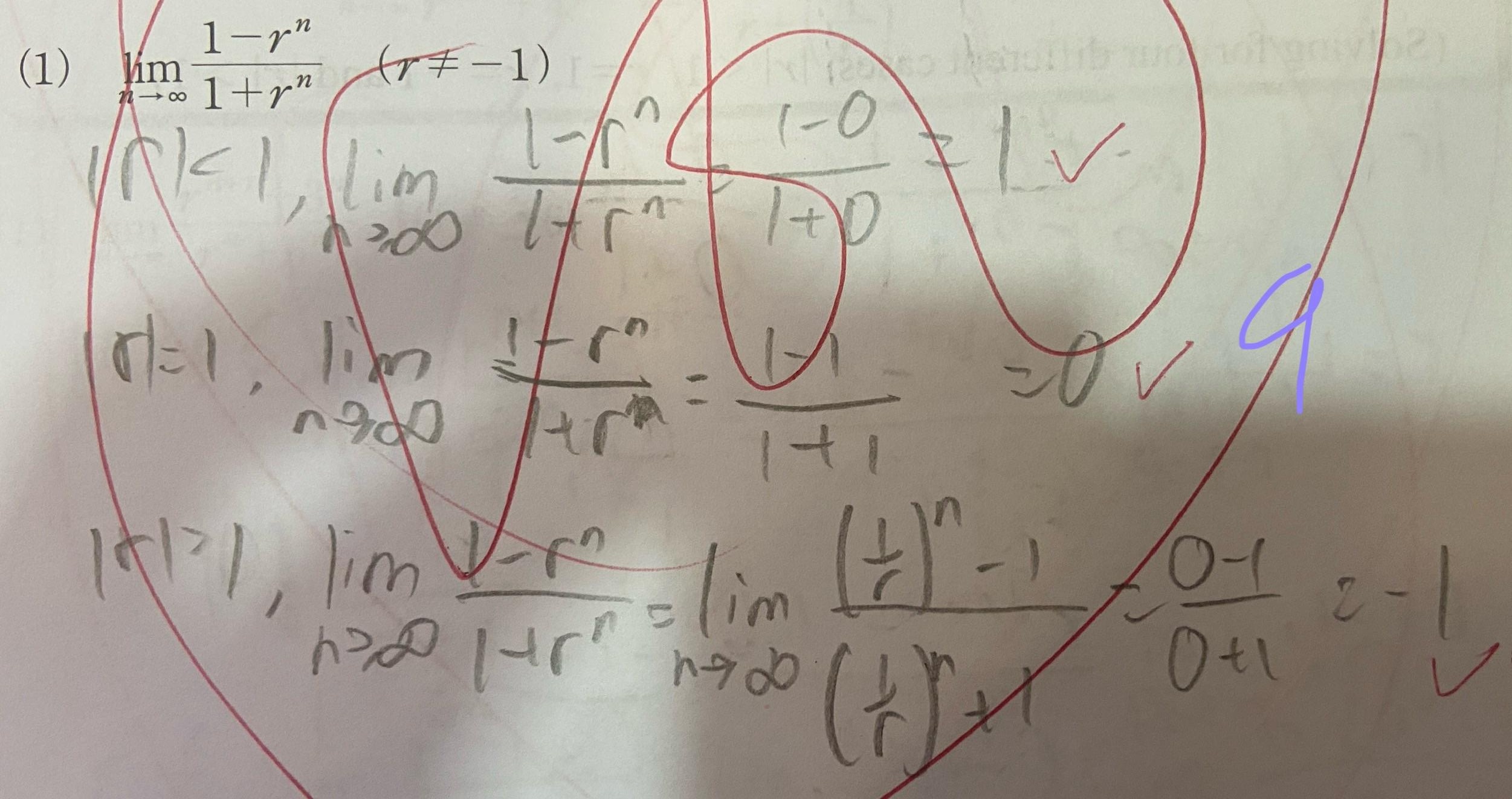
Question 9: Limit of Sequence with Variable Base Parameters

Topic: Limits depending on base magnitude.
Concept: Evaluating convergence boundaries of the sequence $a_n = \frac{1-r^n}{1+r^n}$ for different intervals of the base parameter $r$ ($|r| < 1$, $r = 1$, and $|r| > 1$).
Kumon Level N Q10 Answer

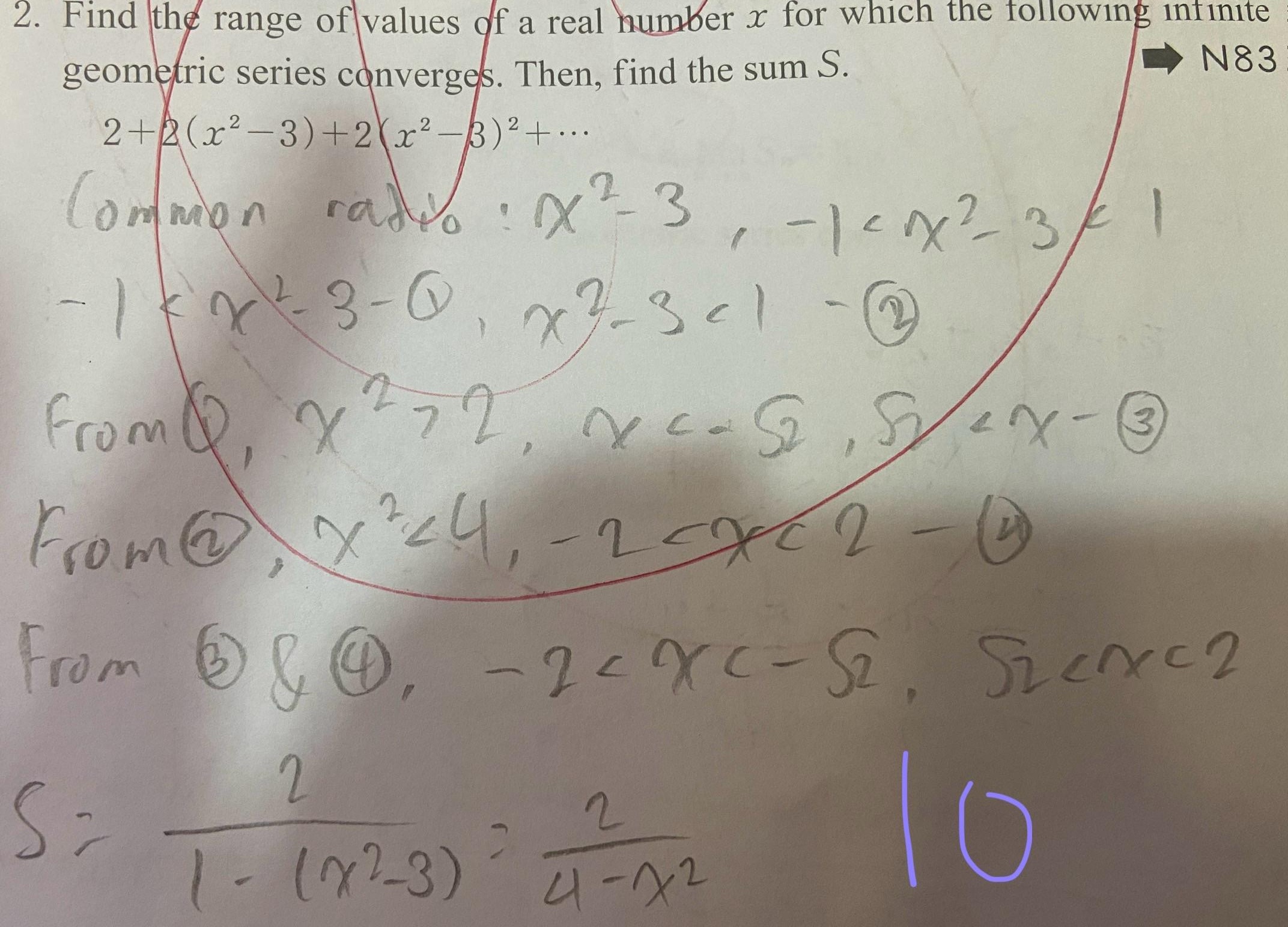
Question 10: Convergence of Infinite Geometric Series

Topic: Sum of infinite geometric series.
Concept: Finding the convergence range and sum of the infinite series $2 + 2(x^2-3) + 2(x^2-3)^2 + \ldots$, which converges when common ratio $|x^2-3| < 1$.
Kumon Level N Q11 Answer

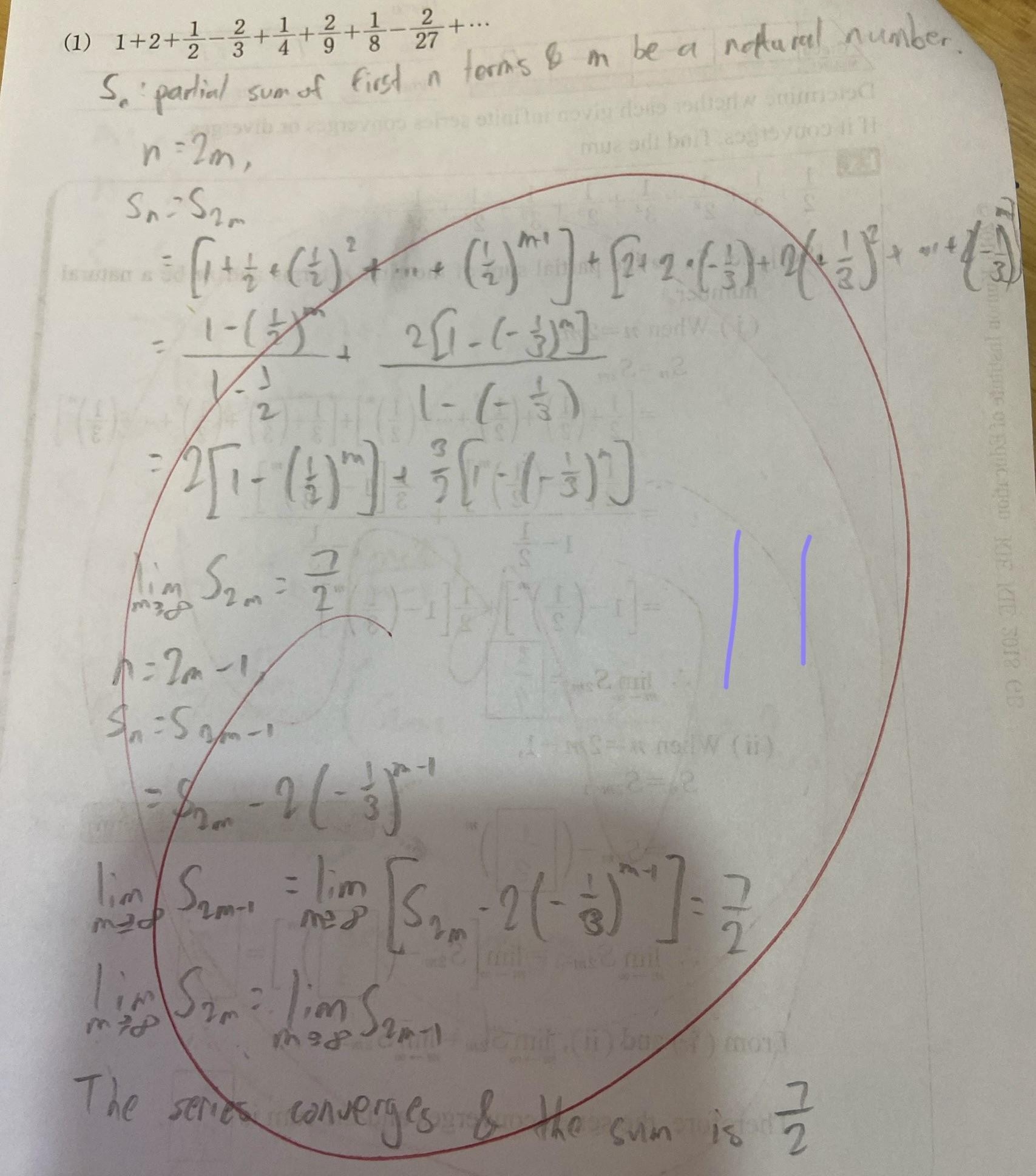
Question 11: Sum of Interleaved Infinite Series

Topic: Convergence of alternating sums.
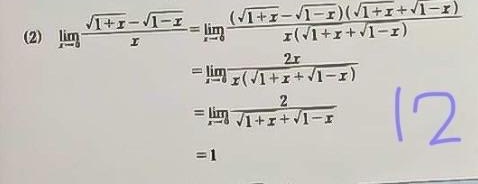
Concept: Calculating the sum of an interleaved alternating infinite series $1 + 2 + \frac{1}{2} - \frac{2}{3} + \frac{1}{4} + \frac{2}{9} + \ldots$ by grouping it into two separate convergent geometric series.
Kumon Level N Q12 Answer

Question 12: Limit of Irrational Functions

Topic: Evaluating limits by rationalization.
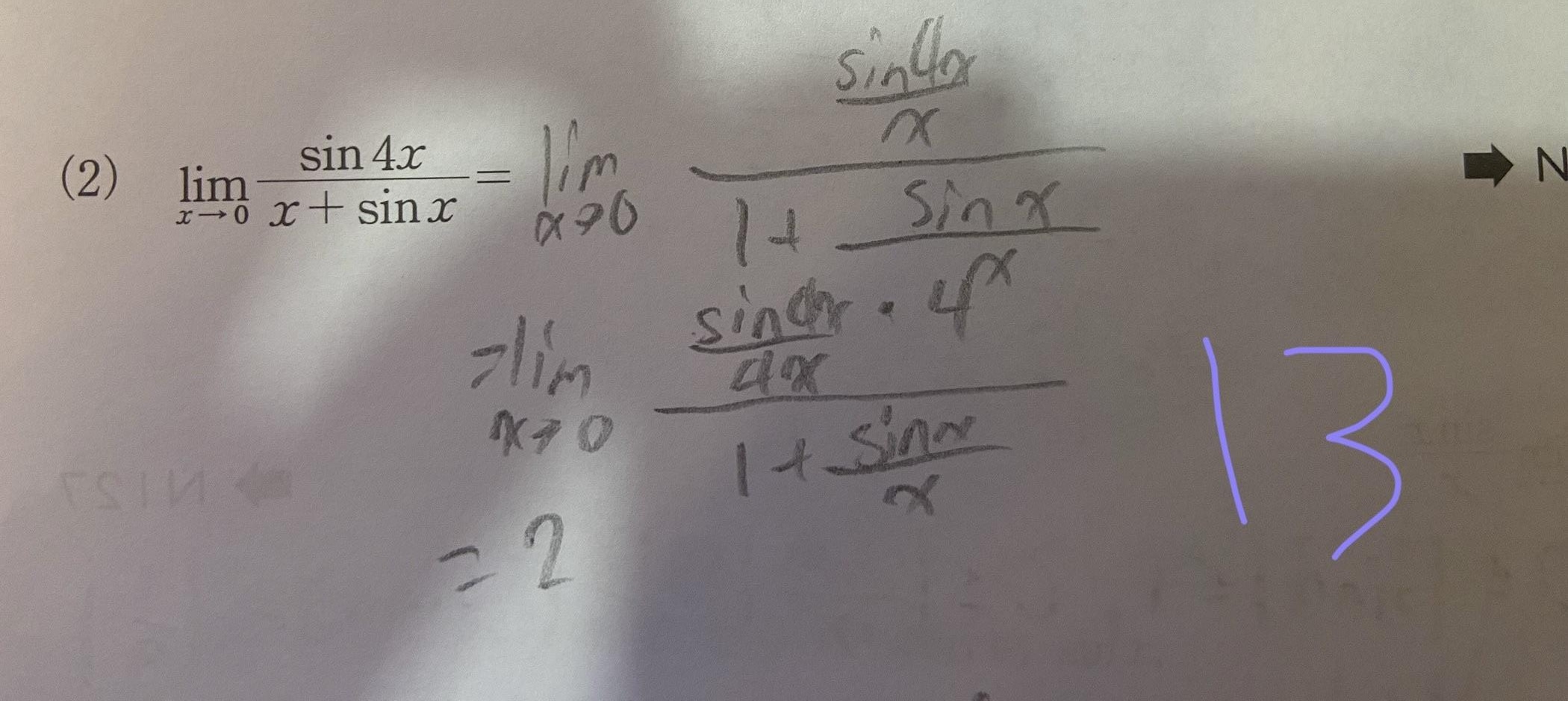
Concept: Using algebraic rationalization to evaluate the limit: $\lim_{x \to 0} \frac{\sqrt{1+x} - \sqrt{1-x}}{x} = \lim_{x \to 0} \frac{2x}{x(\sqrt{1+x} + \sqrt{1-x})} = 1$.
Kumon Level N Q13 Answer

Question 13: Trigonometric Limits

Topic: Fundamental trigonometric limit behavior.
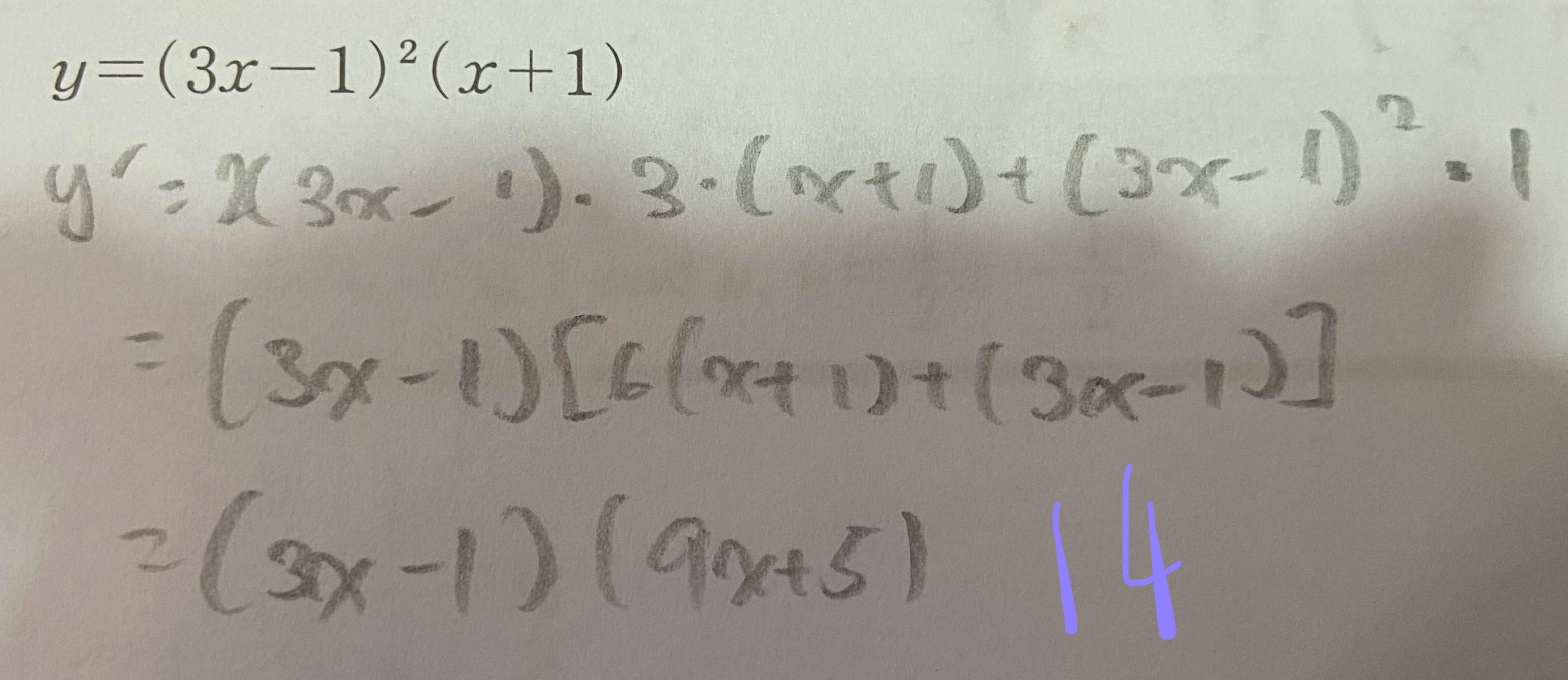
Concept: Evaluating $\lim_{x \to 0} \frac{\sin 4x}{x + \sin x}$ by dividing the numerator and denominator by $x$ and applying the standard limit $\lim_{\theta \to 0} \frac{\sin \theta}{\theta} = 1$.
Kumon Level N Q14 Answer

Question 14: Product and Chain Rules

Topic: Differentiation techniques.
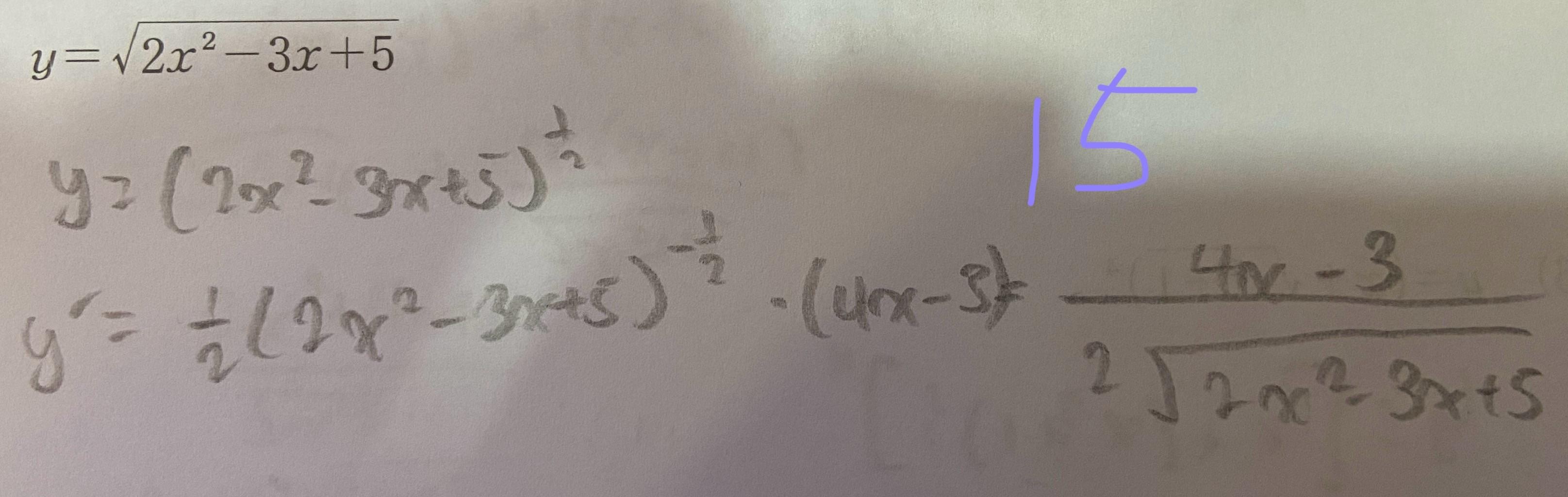
Concept: Finding the derivative $y'$ of the product function $y = (3x-1)^2(x+1)$ by combining the Product Rule and the Chain Rule.
Kumon Level N Q15 Answer

Question 15: Differentiation of Irrational Functions

Topic: Chain rule application on radicals.
Concept: Finding the derivative $y'$ of the composite root function $y = \sqrt{2x^2-3x+5}$ by using the general power chain rule.
Kumon Level N Q16 Answer

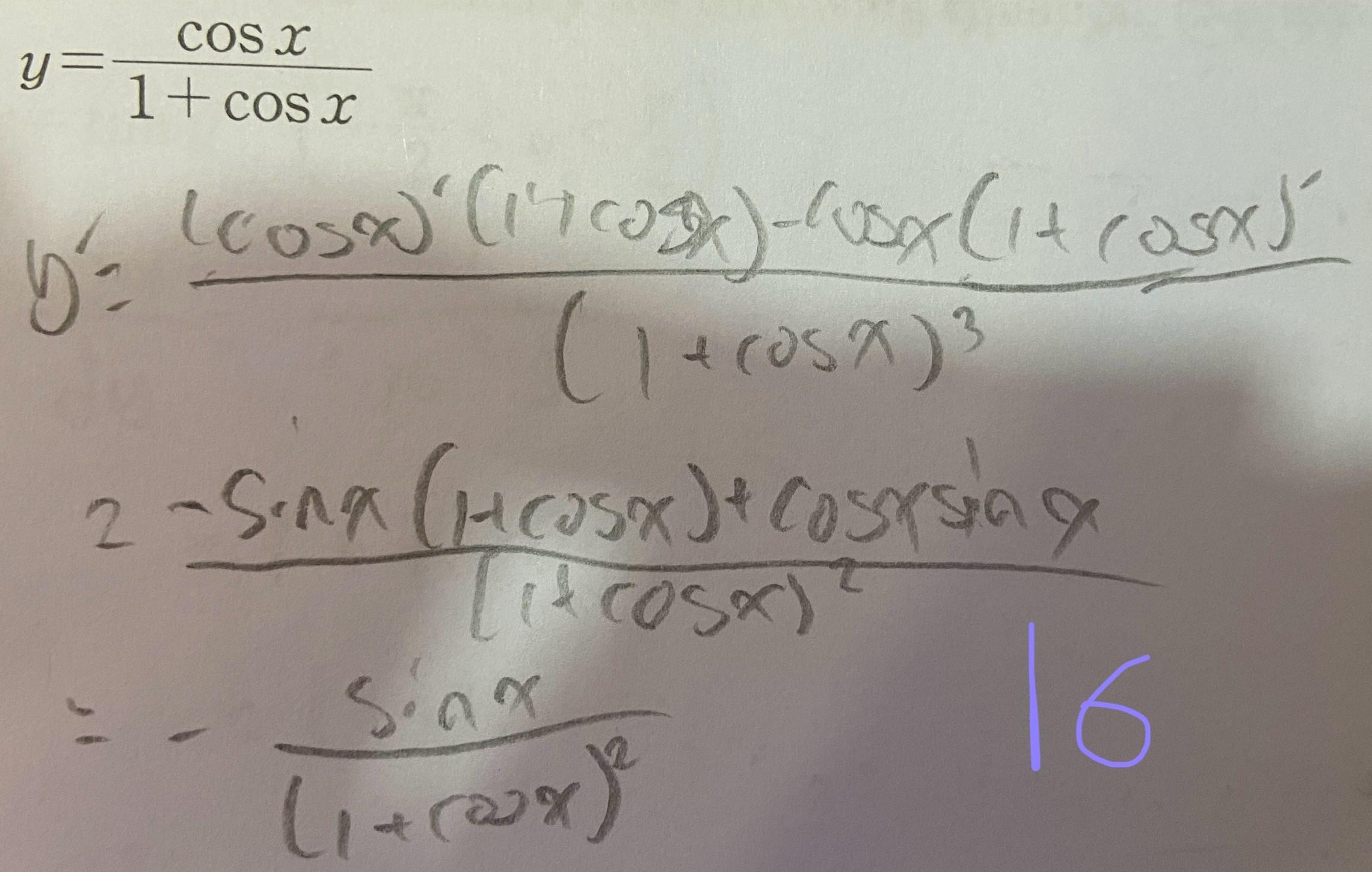
Question 16: Differentiation of Trigonometric Functions

Topic: Quotient rule on trigonometric fractions.
Concept: Finding the derivative $y'$ of the fraction $y = \frac{\cos x}{1+\cos x}$ by applying the Quotient Rule: $\frac{d}{dx}\left[\frac{u}{v}\right] = \frac{u'v - uv'}{v^2}$.
Kumon Level N Q17 Answer

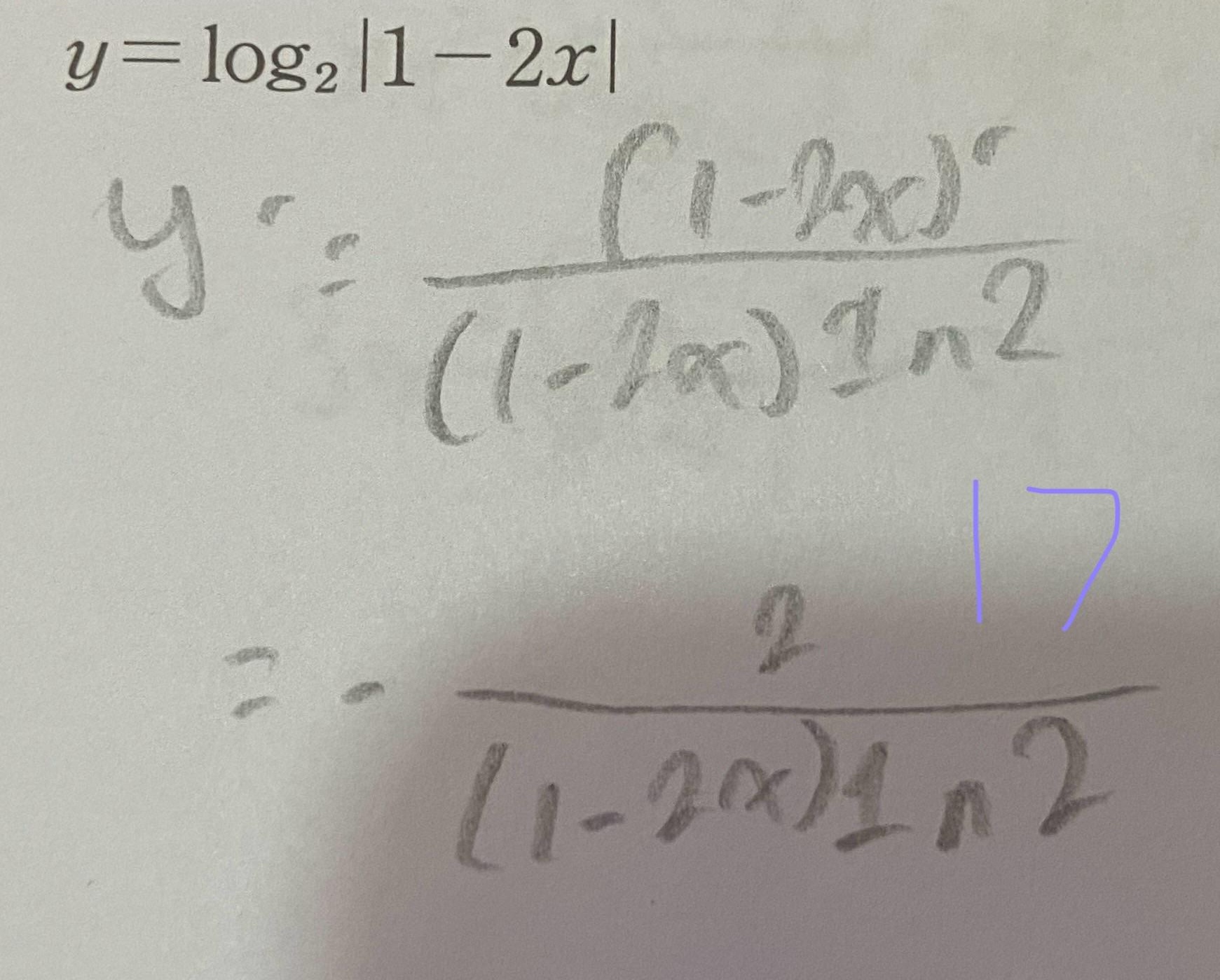
Question 17: Differentiation of Logarithmic Functions

Topic: Derivatives of absolute logarithmic terms.
Concept: Differentiating $y = \log_2 |1-2x|$ by applying natural base conversion and the composite chain rule: $\frac{d}{dx}[\log_a |u|] = \frac{u'}{u \ln a}$.
Kumon Level N Q18 Answer

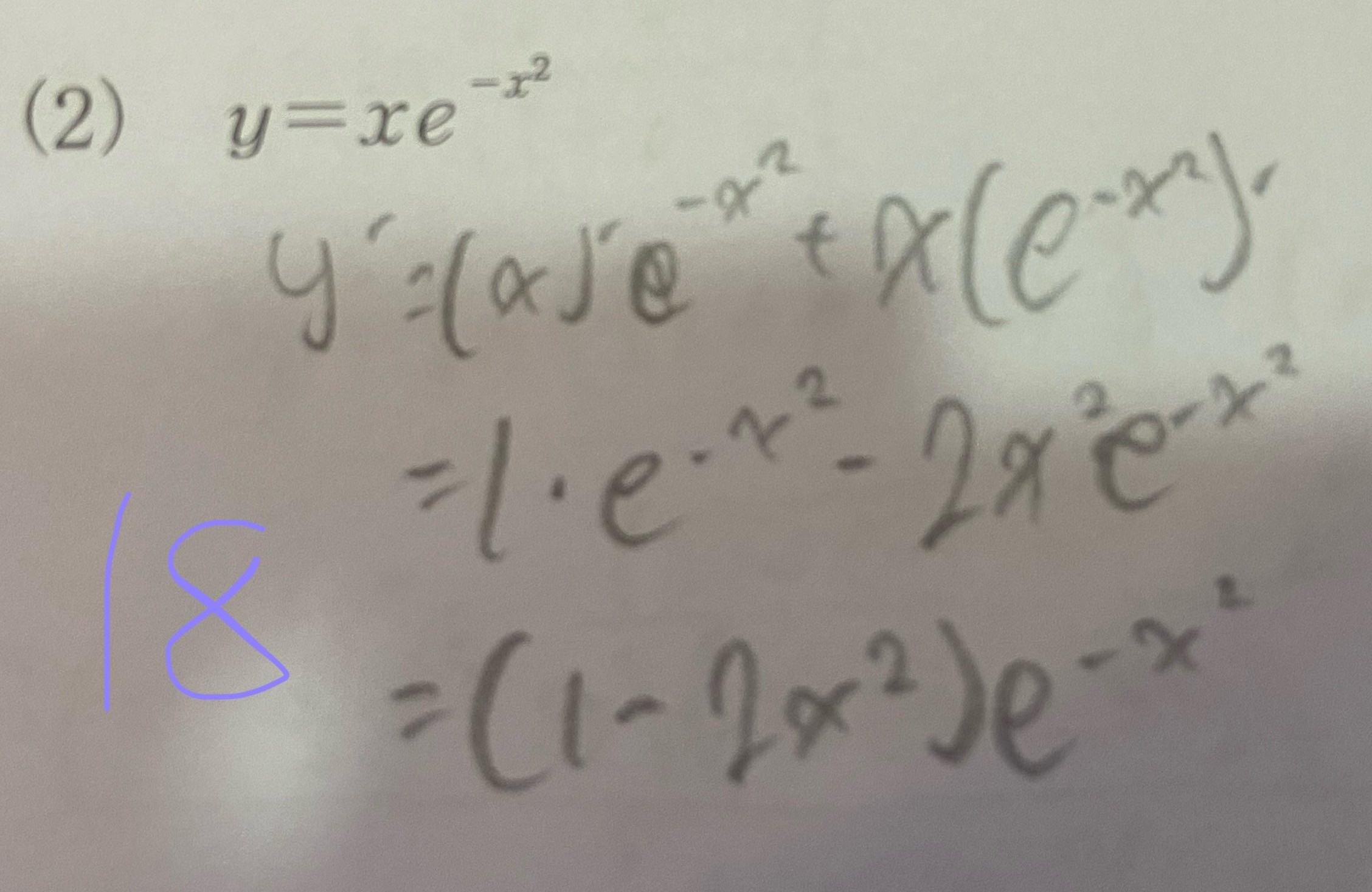
Question 18: Differentiation of Exponential Functions

Topic: Product and chain rule on exponentials.
Concept: Calculating the derivative $y'$ of the function $y = x e^{-x^2}$ using the Product Rule combined with the Chain Rule for exponential terms.
Kumon Level N Q19 Answer

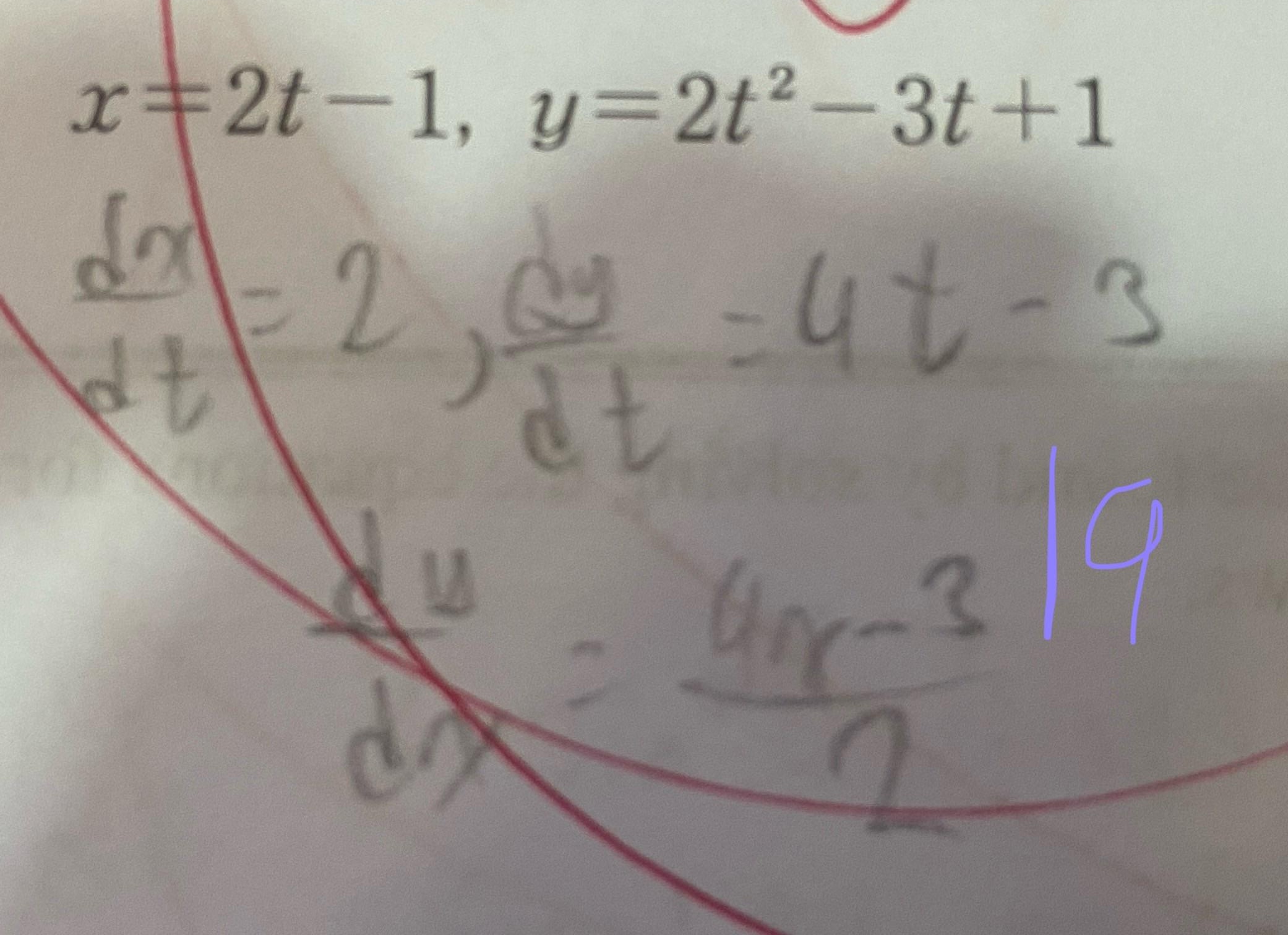
Question 19: Parametric Differentiation

Topic: Derivatives of parametric curves.
Concept: Finding the derivative $\frac{dy}{dx}$ of a curve defined parametrically by $x = 2t-1$ and $y = 2t^2-3t+1$ using the formula $\frac{dy}{dx} = \frac{dy/dt}{dx/dt}$.
Kumon Level N Q20 Answer

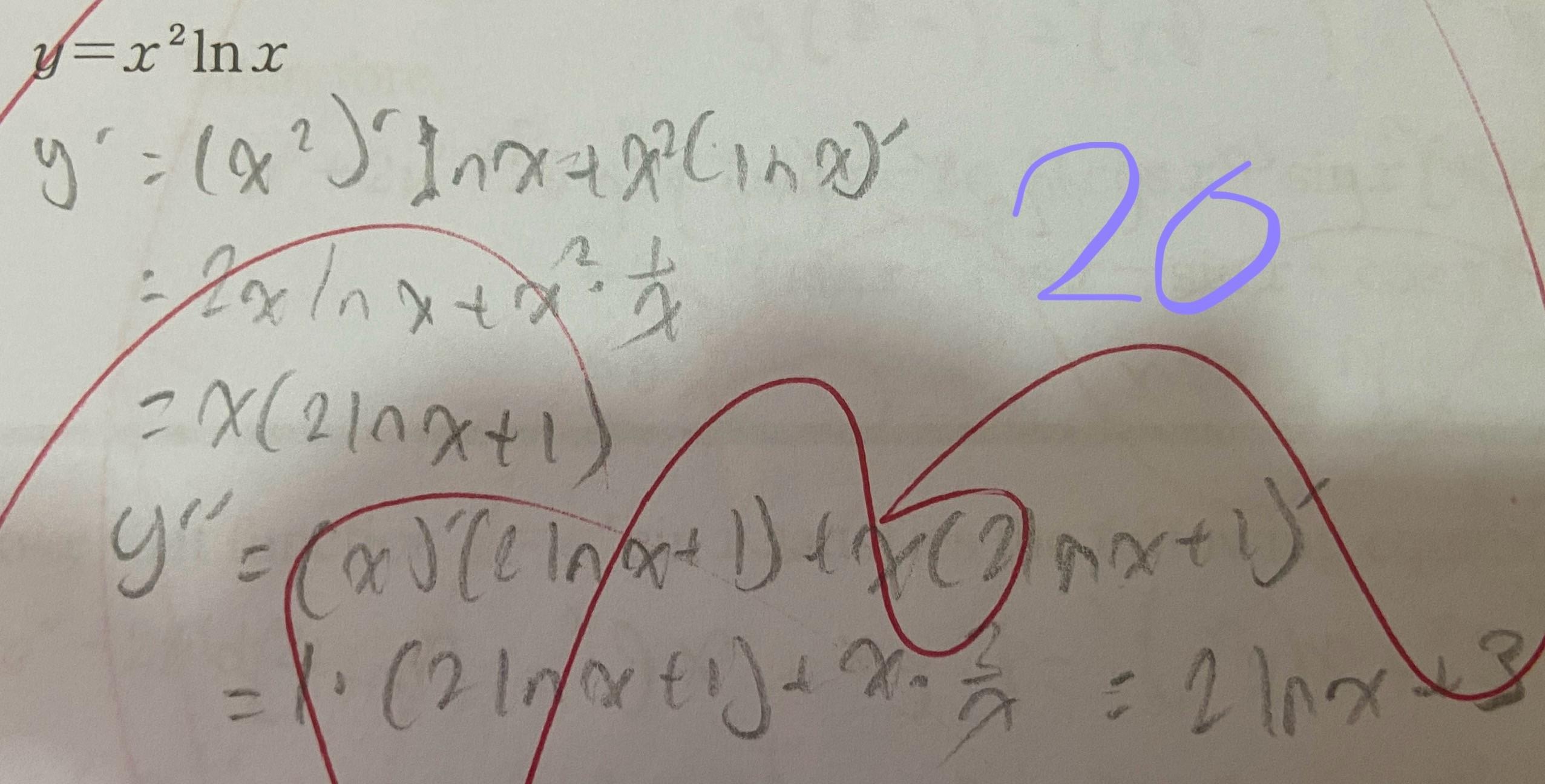
Question 20: Second-Order Derivatives

Topic: Higher-order derivatives of products.

Concept: Finding the second derivative $y''$ of the function $y = x^2 \ln x$ by sequentially applying the Product Rule twice.